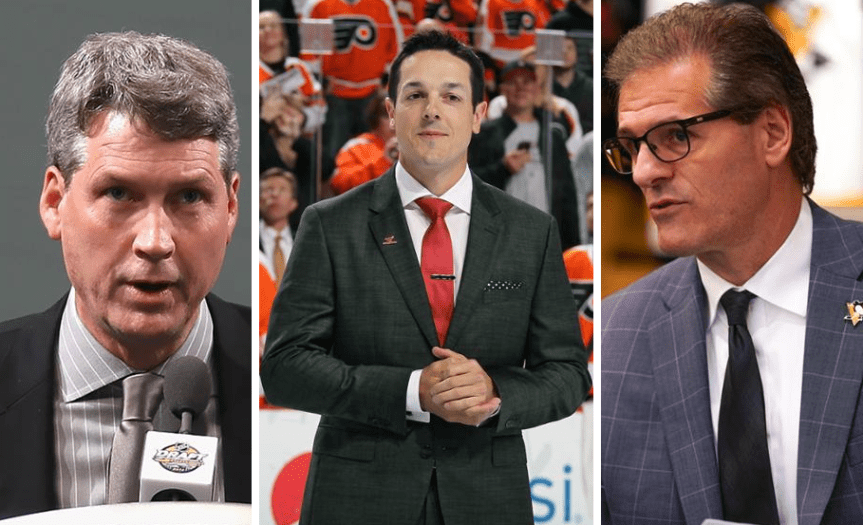
It’s been a tumultuous ten years for the Philadelphia Flyers, and much of that boils down to who’s been running the franchise during that time. Ron Hextall, Chuck Fletcher and Danny Briere have all tried their hand at building the Flyers in their image, and success has yet to be bred because of it.
The first offseason is a time for the new GM to clean up the previous regime’s mess. Making what may be considered unfavorable moves in the name of putting their own stamp on the team and give their first impressions as what to expect for the rest of their tenure. All three GMs had different approaches when they got the opportunity to go to work, and now that Briere’s first summer is in the books, let’s revisit the body of work from each GM during their first few months at the helm of the Philadelphia Flyers.
Ron Hextall
Hextall’s first offseason was significantly less busy than both his successors, but it set the tone for his entire stint with underwhelming depth roster moves taking center stage with a classic very good trade to make his plan of a “rebuild” seem attractive at face value.
His biggest and most notable move ended up was his first, being a trade that sent fan-favorite Scott Hartnell to Columbus in exchange for R.J. Umberger. It was theoretically a cap move (Umberger had three years left at $4.6 million aav and Hartnell had five years left at $4.7 million aav) but Umberger was a terrible downgrade and both players were bought out of their respective deals anyway, Umberger in 2016 and Hartnell in 2017.
His signings during 2014 offseason play all the hits from everyone’s Flyers PTSD. They include Pierre-Edouard Bellemare, Nick Schultz, Michael Del Zotto, Ryan White and Carlo Colaiacovo. They also re-signed Kimmo Timonen to a one-year deal, but he wouldn’t play for the Flyers again due to blood clots. He won a Cup with Chicago after being dealt at the trade deadline.
Hextall also retained the services of head coach Craig Berube for the 2014-15 season, damn near causing a mutiny from the fanbase in the process.
There was the first miracle Hextall trade when he dealt depth forward Tye McGinn to the San Jose Sharks for a 2015 third round pick that ended up becoming Felix Sandstrom. He’d later replicate a similar deal when he shipped Zac Rinaldo to Boston for a third round pick that became Kirill Ustimenko the following summer.
Hextall had plenty of promises and dreams of grandeur, but failed to meet any of them. He let a main roster with plenty of talent in their primes like Claude Giroux, Jake Voracek, Brayden Schenn, Wayne Simmonds and Sean Couturier waste away and never once made a main roster upgrade (until he signed James Van Riemsdyk in 2018 but that’s a very generous use of the word upgrade), yet never sold any of his stars off either until he dealt Schenn three years later. There wasn’t a single one of his overhyped prospects the Flyers can’t or couldn’t live without; many are no longer with the organization anyway. He pledged a rebuild, then did the absolute bare minimum to stick to those guidelines and his “process” failed because of it.
Chuck Fletcher
It’s easy to forget given how atrocious the last few years of his tenure were, but Fletcher’s first offseason at the helm was actually decent. He was hired on December 3, 2018 and he went to work immediately, trading Jordan Weal to Arizona, then Christian Folin and Dale Weise to Montreal a few weeks later.
As the trade deadline approached, he swapped goalie Anthony Stolarz for Cam Talbot (whom Scott Gordon misused so badly he refused to re-sign), then dealt Wayne Simmonds, who was long past the prime of his career, to the Nashville Predators in exchange for Ryan Hartman and a fourth round pick in 2020.
Valtteri Filppula, Brandon Manning and Jori Lehtera left in free ageny and Andrew MacDonald was finally bought out of the last year of his $5 million aav contract.
He would make a trio of trades, acquiring the rights to Kevin Hayes and subsequently signing him to a seven-year, $50 million extension, then picked up defensemen Matt Niskanen and Justin Braun from Washington and San Jose respectively.
He made two moves at the draft, moving back three spots to select Cam York 14th overall and later packaging a pair of picks to move up and take Bobby Brink in the second round.
Fletcher’s first summer gave the Flyers their last hurrah before doom struck. 2019-20 was the last time they won 40+ games and the last time they’d make the playoffs, thanks in big part to the moves Fletcher made during the offseason. The pandemic threw the red hot Flyers out of balance and the team never really recovered after 2020 playoff bubble, spiraling further and further out of control over the following few years. Compared to Fletcher’s hands-off approach during later his later years, it’s borderline amazing that he was able to competently make the additions and subtractions he did during the 2019 offseason.
Danny Briere
The much awaited coronation of Danny Briere finally took place during the 2023 offseason after Fletcher got canned post-trade deadline when he failed to move James Van Riemsdyk and the mounting pressure from the fans was finally too great to ignore. The franchise used a tactic of building a front office composed entirely of former Flyers with minimal or no previous experience in their new roles, with Briere’s 12-month tenure and an assistant to Fletcher the only notable accomplishment he had in an NHL front office.
To be fair to Briere, the salary cap was still, for all intents and purposes, flat. Moves are more difficult to make now that they were in either of Hextall’s or Fletcher’s first summers at the helm. However, there was plenty of smoke around many of the players on his roster that did not move.
Briere was unafraid to use the term “rebuild” in his press tours leading up to the offseason, and got off on a good foot following up on that by trading Ivan Provorov to Columbus in a solid three-team trade that also included the Flyers eating the contract of Cal Petersen in LA for extra assets.
Unfortunately, he wasn’t able to muster more than that when it came to trades indicating a rebuilding trajectory. Both Travis Konecny and Scott Laughton were not moved despite each having career seasons and were popular options in the league-wide rumor mill. Briere also failed to ditch Travis Sanheim’s eight-year extension before the no-trade clause kicked in on July 1.
He traded Kevin Hayes to St. Louis, but retained half of his salary to do so, then ultimately had to buy out Tony DeAngelo after a trade with Carolina fell through, which left a $5.2 million combined tab of dead cap on the books for the 2023-24 and 2024-25 seasons.
Briere did redeem himself at the draft. He selected Russian forward Matvei Michkov seventh overall, took defenseman Oliver Bonk 22nd overall and moved up into the second round to take the number one ranked North American goaltender Carson Bjarnason.
His free agency was reminiscent of the Hextall days, when he committed over $5 million in cap to depth forwards Ryan Poehling, Garnet Hathaway and 36-year-old defenseman Marc Staal.
Briere’s efforts weren’t as much a rebuilding strategy as it was re-arranging deck chairs on the Titanic. A teardown did not happen. A salary cap cleansing did not happen. Yet, despite more questionable moves than good ones, there was very little public backlash to his debatable strategy. At the end of the day, more could’ve and should’ve happened to shake up a very stale product.
Time will tell if Briere has what it takes to be GM. The salary cap is finally expected to rise in 2024 and movement across the league will slowly but surely start to happen again. There were indications that Briere has the smarts to build a successful team as seen by the Provorov trade and the wherewithal to select Michkov, but whether or not he can execute his strategy will be the main storyline over the next few seasons.
It’s where Briere’s predecessors failed. The sheer level of inactivity both Hextall and Fletcher had in their later years was a major reason the Flyers reached the depths they have. There was just enough hesitation from Briere when it came to pulling the trigger on moves that it’s fair to wonder whether his tenure will be any different. The 2024 trade deadline and offseason will paint a much more vivid picture as to what to expect from the rookie GM, but it’s safe to say that his first impression wasn’t as good as it could’ve been.
By: Dan Esche (@DanTheFlyeraFan)
photo credit: nhl.com
 brotherlypuck.com