With the 2023 NHL Entry Draft and the start of Free Agency in the rearview mirror, fans spend the glorious summer months eagerly anticipating the start of training camp and the boundless optimism that a new season brings. In Philadelphia, Flyers fans are obviously excited by the drafting of Matvei Michkov with a tangible buzz surrounding this team for the first time in a long time.
What will the Flyers be like this upcoming season? Will they show improvement in the standings? How will Sean Couturier and Cam Atkinson fare in their return to the lineup after prolonged injuries? Will young players like Owen Tippett, Noah Cates, and Cam York continue to grow and take strides this season?
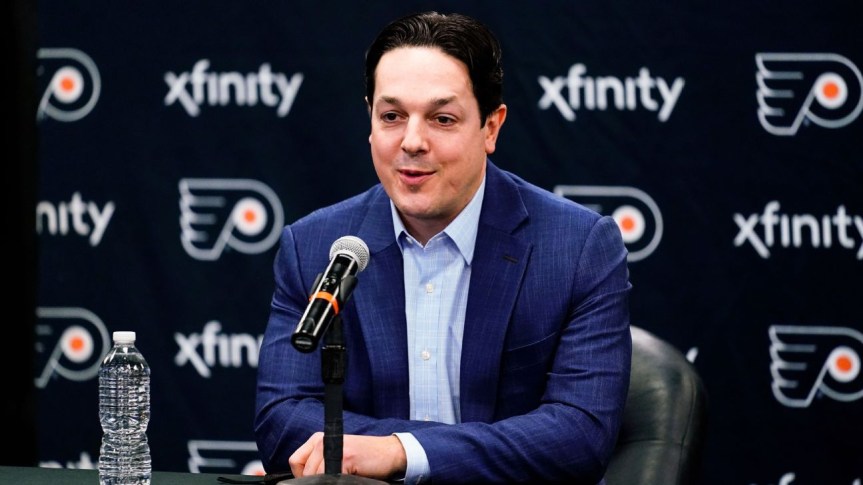
More amazing, is how high the level of engagement and excitement is in the midst of a rebuild. Head Coach John Tortorella stated that the Flyers were in a rebuild even when the previous General Manager Chuck Fletcher refused to use the term. With the dismissal of Fletcher and the hiring of new GM Daniel Briere, the word rebuild was used officially by the organization in an attempt to communicate a path for an organization that seemed to lack direction and purpose.
As the legendary New York Yankee and Baseball Hall of Famer Yogi Berra famously quipped, “When you come to a fork in the road, take it”. For those familiar with Berra’s memorable quotes, you will note the role that irony and interpretation have in the impact of the statements themselves.
While the Flyers have selected their path in the proverbial ‘fork in the road’, debate has brewing about how much of a success this offseason has been in terms of implementing the rebuild. Repeatedly in press conferences last season, John Tortorella stated that the Flyers were in the very early phase of the rebuild and that a long-haul approach was needed to build the team up the proper way. Briere has also echoed the calls of his Head Coach for fans to be patient with this process as it unfolds and to expect growing pains.
If we can categorize the 2022-2023 season as ‘Stage 1’ of the rebuild, can we look at the goals of the organization and examine how successful the club has been in achieving them and figure out what ‘Stage 2’ of the rebuild will look like?
The Rebuild: ‘Stage 1’
Being the first in the organization to call the process that the Flyers were embarking on as a rebuild, John Tortorella’s comments in assessing the team and describing the 2022-2023 season were just the beginning part of the process. While many still debate whether or not the Flyers attempted a rebuild during the Ron Hextall era, the use of the term rebuild was purposely designed to leave no ambiguity for the current and future plans of the organization.
The opening stages of this rebuild as defined by John Tortorella, was to “see what we have” and identify the players that will continue to be a part of the team moving forward. The other element of this opening stage was to identify the players that will not be a part of the process going forward and have no future with the organization. Tortorella teased that changes to the roster would be forthcoming during the offseason by phrasing it as “subtraction” that needed to take place.
Ivan Provorov was the first subtraction made to the roster (as well as the first trade executed by GM Daniel Briere) with a haul of draft capital and defensive prospect Helge Grans acquired by Philadelphia. In a complex opening move that involved three teams and salary retention, the Flyers also had to take on the contracts of Defenseman Sean Walker and Goaltender Cal Petersen. While Walker fits the profile of a player that could be in demand at the trade deadline, the acquisition of Petersen and his contract (2-years at $5 million AAV) is fascinating. While the Flyers no doubt had to take back Petersen’s undesirable contract in order to extract the 2023 1st Round pick from the Los Angeles Kings, it also ‘adds’ another body to the roster when ‘subtraction’ was the arithmetic prescribed for the offseason. By preaching patience and acknowledging how far the Flyers are to contending for a playoff spot, fans will correctly point out that absorbing a bad contract makes plenty of sense for the position that the Flyers are in and how much runway needs to be made up in order to get the team back on track. The path was communicated to the fans and the Provorov trade clearly was a large step towards practicing what is preached in terms of taking steps towards turning over the roster.
At the 2023 NHL Draft, the Flyers selected forward Matvei Michkov at #7 overall to address the most significant need of the Flyers, which is the need of elite high-end talent. Michkov checks all the boxes of a future superstar in the making, with many prospect pundits putting him second only to Connor Bedard in terms of offensive creativity and ability. While the Flyers will have to wait for Michkov to come to the NHL as he is under contract to SKA St. Petersburg of the KHL until the end of the 2025-2026 season, they obviously felt that his talent would be worth the wait and would allow the rebuild to continue. In a sense, the drafting of Michkov has given a timeline to the rebuild whereby the Flyers essentially have to complete and establish the foundation of a team that is ready to compete over the course of the next three seasons. At such time Michkov would not only be a contributor immediately in his rookie season, but should be able to push the team to another level competitively and be on a cost-effective 3-year ELC to boot.
In addition (pun intended), the Flyers had a successful rest of the 2023 draft with the selections of defensemen Oliver Bonk, goaltenders Carson Bjarnason and Egor Zavragin, and forward Denver Barkey (among others). With the timeline established above, these players will have ample time and opportunity to continue developing their skills over the coming seasons with less pressure to make the jump to the professional ranks until they are absolutely ready to do so.
Back to the subtraction.
In the week prior to the draft, rumors swirled heavily that both Kevin Hayes and Travis Sanheim would be traded to the St. Louis Blues, but the deal fell apart with Blues Defenseman Torey Krug refusing to waive his no trade clause to go to Philadelphia. After the draft Hayes was eventually traded to the Blues, but the Flyers had to retain half his salary for the next three seasons and only received a 6th Round pick as compensation. Purely a move to jettison a player who did not see eye-to-eye with John Tortorella, the return was completely underwhelming and shows that the need to trade Hayes as a player that did not fit the team’s plans moving forward was the most important factor at play.
Much of the same could also be said for Defenseman Tony DeAngelo, whose trade to the Carolina Hurricanes didn’t materialize as quickly as the Flyers would have liked, so they bought out the remaining year of his contract (and actually saved more money against the cap than if they were to have retained half of his salary via trade). There is no doubt that an incident occurred between Tortorella and DeAngelo which led to the player being benched for the final five games of the season.
The Flyers were not expected to be big players in Free Agency, but Briere did make a few signings by adding Center Ryan Poehling (1-year $1.4 million AAV), Right/Left Winger Garnet Hathaway (2-years $2.375 million AAV), and Defenseman Marc Staal (1-year $1.1 million AAV). All these additions provide experience to a younger roster and continues to follow the mantra of making the Flyers “tougher to play against”. They are also on short term deals, which will not hamper the Flyers from both a contractual as well as a salary cap perspective going forward.
However, there was some criticism of these signings. Why? The answer lies in trying to project what the next phase (Stage 2) of the rebuild should entail.
Projected ‘Stage 2’
If ‘Stage 1’ was characterized as “finding out what we have on the roster” and ‘subtracting’ players from the roster that do not fit with the Flyers plans moving forward, then it would appear that the 2023-2024 season will be a continuation of that process. While the majority of Flyers fans are pleased with the performance of Briere this past offseason, there are some who believe that the Flyers simply did not go far enough with the ‘subtraction’ of players on the roster. Some of it no doubt is the frustration that the Travis Sanheim trade fell apart, and I personally don’t blame Briere for that. He clearly was trying to trade a player with a difficult contract to move with the spectre of the NMC kicking in on July 1st. He tried his damnedest, but ultimately the deal couldn’t get done because Torey Krug exercised his right to rescind the deal.
Other players on the roster could have been moved though. Scott Laughton was heavily involved in trade speculation in the week prior to the Draft, and multiple sources reported that there was significant interest. Travis Konecny also saw his name pop up with interest from the Detroit Red Wings and the Ottawa Senators being the most prevalent. While the rumors of a Konecny trade were not as strong as those involving Laughton, the smothering of those rumors in short order indicated that the Flyers were just not ready to move on from the player or that the rumors themselves were not as concrete as some would have you believe.
With Laughton though the rumors persisted for some time with Frank Seravalli and Elliotte Friedman reporting the strength of the discussions from around the league. Seravalli in particular tweeted that the Blues alleged offer was a 2023 1st Round pick and a future 2nd Round pick. Even if Seravalli wasn’t completely accurate in the return (as some on Flyers Twitter allege), the fact remains that any potential return for Scott Laughton would be significant for a team that was going through a proper rebuild judging from the amount of interest. The liquidation of as much of the roster as possible would be indicative of a rebuild in its most traditional sense.
The reason why this liquidation phase is so significant, is that roster spots should be opening up for the young prospects in the system that should be ready (or close to ready) to push for a regular place in the lineup. After his 8 GP last season, Tyson Foerster should be a virtual lock to make the roster out of training camp after scoring 3 goals and 4 assists in his limited time last season. Fans may declare that prospects shouldn’t be given a spot until they have earned it, but Foerster looked ready for full time duty especially considering his good AHL campaign as well. If Foerster does not make the roster out of camp, it clogs up the pipeline for players like Bobby Brink who not only plays the same position as Foerster but would not get the deployment of top-line minutes that he would likely get if Foerster makes the jump to the NHL. While the signings of Hathaway and Poehling shouldn’t be a deciding factor on Foerster making the big club, the defense is clearly another story.
With the Provorov trade and the buyout of Tony DeAngelo, slots opened up on the left and right sides of the roster. On the left side; Sanheim, Cam York, Nick Seeler, and the newly signed Marc Staal are on the roster while the right side would feature Rasmus Ristolainen, and Sean Walker. Keeping in mind that York was used on the right side for most of last season (although he plays more naturally on the left), that fills up the defense corps with players like Egor Zamula (LHD), Ronnie Attard (RHD), Helge Grans (RHD), and Emil Andrae (LHD) in the pipeline looking to try to make the team out of camp or at least show that they are close. While Grans should start in the AHL to get familiar with new teammates and a new organization; it leaves Zamula and Attard to compete for a spot on the roster and to leapfrog one of the veteran defenders on the team.
Again, in theory players should absolutely earn a roster spot but Zamula in particular is not waiver exempt and signed a one-year deal. The mantra last season was that the organization needed to “see what they have”, and Zamula is a prime example of a prospect that they need to make a decision on this season. He was signed as an undrafted player in 2018 and has played 127 games at the AHL level with the Lehigh Valley Phantoms (5 goals and 49 assists for 54 points) and 26 games with the Flyers (4 assists). His time is now to show if he can be a player for the Flyers moving forward or not, and a concrete decision shouldn’t be made without allowing him the opportunity to sink or swim at the NHL level.
While less imminent, Ronnie Attard is in a somewhat similar predicament. A 3rd Round pick from 2019, the 24-year old played the bulk of the season with the Phantoms by featuring in 68 games (12 goals and 20 assists for 32 points) and playing 17 games over the last two season in the NHL (2 goals and 2 assists for 4 points). With a two-way contract, Attard can certainly go between the AHL and NHL without being exposed to waivers. It would seem likely that Attard would start in the AHL and would be called upon to fill in with the big club in case of an injury on the right side. If he is in the AHL, it would impact the minutes and deployment of Grans who also plays the same side. Ideally, both players should be in a position to maximize their minutes and exposure to different situations in order to continue ironing out deficiencies in their respective games.
And then there is Emil Andrae.
Andrae is the most talented of the defensemen currently in the system, and as such should be a focal point for the player development staff. He is only 21-years old with a plethora of experience at various levels in Sweden as well as internationally. He played 10 games with Lehigh Valley this past season (2 goals and 4 assists for 6 points) and turned heads with his play while getting used to the North American game. He has impressed the Flyers brass, with both GM Daniel Briere and AGM Brent Flahr singing his praises as a player that they fully expect to compete for a roster spot at training camp. The problem here though is that there is a clause in the transfer agreement between the NHL and the Swedish Ice Hockey Federation that gives Andrae’s Swedish team HV71 the right to recall the player if he does not make the NHL roster.
Andrae could handle another year in either the Swedish league or the AHL to round out his game. But the issue appears if the player makes the Flyers out of training camp. While many fans will be excited because he has earned a spot, questions still remain unanswered. Who did Andrae leapfrog in the defensive depth chart? Will he be playing consistently, or will he be in and out of the lineup? With Andrae in the lineup, does Tortorella put more emphasis on playing his veterans or will he be comfortable using a defense with younger players to give them the minutes they need in order to properly evaluate them?
In a sense, many fans would argue that a young player entrenching themselves on the roster is a great problem to have. Very true. But it also is important to remember that this upcoming season should not be about which one of the defensive prospects can establish themselves on a team where making the playoffs is a pipedream. The season should be about evaluating the players in the Flyers’ system to see if they are going to be a part of the team when it is ready to take the next steps towards contending. That means giving opportunities to play significant minutes in various situations to see where they are at. That evaluation was done last season for the players on the roster and should be done for the prospects in the system this upcoming season.
Conclusion
The logjam on the defense in particular means that decisions on the deployment and playing time for the young defensive prospects may be done out of circumstance rather than necessity. Teams that find themselves in the Flyers situation should not be making decisions in this fashion. They need to embrace the development stage of the rebuild to fully grasp and understand the talent level that they currently have in order to make better decisions to supplement their roster going forward. Otherwise, the upcoming season will be condemned to be a repeat of the previous season.
Fans need something to look forward too. They cannot and should not be expected to simply wait for Michkov to come over in a few years time. While I don’t believe that the organization feels that way, taking steps forward and continuing to evaluate the roster with player development in mind for the prospects in the system will make the rebuild process more bearable for fans. It is the definition of “doing things the right way”. It follows through on requiring the fans to be patient because it doesn’t just expect the status quo to continue with little change in order to rebuild. Hard decisions will have to be made and not every player drafted as a prospect will be a part of this team going forward. But those decisions have to be made with a good deal of certainty that can only come if young players are given real opportunities to play and information can be gathered. Otherwise the upcoming season runs the risk of redundancy with the focus remaining on evaluating the players on the roster rather than the prospects in the system.
To revisit the wise words of Yogi Berra; “When you come to a fork in the road, take it”. Flyers fans have seen the team choose the rough and winding path of the rebuild. They now have to continue down that path and ensure that the upcoming season is not just a repeat of the previous season in terms of evaluation and development.
Otherwise, the Yogi Berra quote that will be ever-present to Flyers fans this upcoming season will be, “It’s like déjà vu all over again”.
***
Do you agree with the article? Do you disagree?
Feel free to leave any comments or feedback via twitter or at www.brotherlypuck.com. .
Until next time from BrotherlyPuck.com,
I remain,
Manny Benevides
 brotherlypuck.com