
‘Ask and you shall receive’.
Fans have been craving the return of international hockey with NHL players. With NHL players last playing in the Winter Olympics at Sochi in 2014, the NHL has committed to returning for the 2026 edition of the games in Milan, Italy (with Ice Hockey currently slated to play in Turin). Sure, NHL players have donned their national sweaters for the World Hockey Championships every year, but it isn’t a best-on-best tournament as it only features NHL players whose teams have been eliminated from the Stanley Cup Playoffs.
The NHL has announced a new tournament called the 4-Nations Face-Off; which will feature Canada, Sweden, Finland, and the United States from February 12-20, 2025 and will be hosted by Montreal and Boston. Like the Olympics though, Russia and Belarus continue to be excluded from organized competitive sporting events due to the continuing conflict in Ukraine. Unless drastic changes occur on the international stage, the political situation means significant limitations to the format and participation of NHL players in international hockey tournaments.
With those limitations in mind at least there is international hockey planned for fans to enjoy. On the downside, a hockey tournament limited to only four countries is sure to make many fans and players scratch their heads. Russia is a traditional hockey nation whose exclusion drastically alters the competitive field. Limiting participation to four nations also is dismissive to countries like Czechia and Slovakia who have a long history of contributions to international hockey. It also ignores the great strides made by countries like Switzerland and Germany to develop high quality players and grow the game’s popularity.
Is there a way to mitigate these negative omissions? Is there a way to include NHL players from countries that were snubbed? Can the NHL provide ways to showcase it’s talent more effectively and promote young stars?
It may not be a popular answer, but maybe the NHL should consider a Team Europe.
Team Europe Revisited?
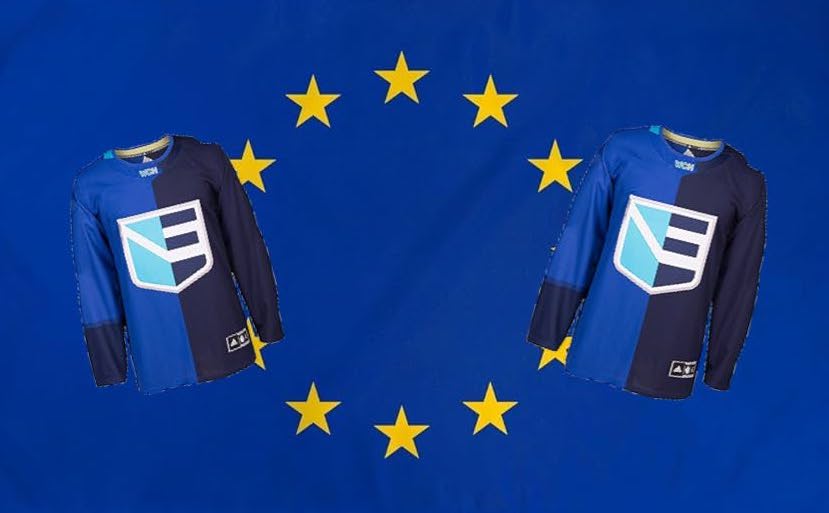
Team Europe was already used in the 2016 World Cup of Hockey. The justification at the time was that many star players in the NHL couldn’t participate because some nations (ie. Slovenia) just didn’t have enough players to form a roster. But it wouldn’t be fair to exclude a marketable star like Anze Kopitar who was one of the best forwards in the world from a best-on-best tournament. Additionally, it would also allow for the NHL to create a Team North America which would be comprised solely by Canadian and American players under the age of 24 to be marketed by the league. The NHL expected to cash in on a financial windfall of about $130 million in revenue ($65 million in profits) according to the Financial Post (Sept. 23, 2016). The estimated haul of about $60 million (according to The Globe and Mail on Sept. 30, 2016) fell well short of expectations and helps to explain the tournament’s hiatus.
None of that is on Team Europe though (hideous hockey jersey’s notwithstanding).
Team Europe exceeded expectations in the tournament and upset Sweden 3-2 in the Semi-Finals thanks to a two-goal performance by Tomas Tatar. Although Team Europe would fall to Canada in the two-game Final, they lost by the respectable scorelines of 3-1 and 2-1. A great showing for a group of players thrown together to play under the banner of a continent rather than a nation.
The idea of a European team shouldn’t be that outlandish anyways. Most Europeans under 50 years of age have favorable opinions about a unified Europe (European Union) and have included it as a part of their identity along with their nationality. After a victory, the European Union’s anthem (Beethoven’s Ode to Joy) could be played over the arena’s loudspeakers and the catchy melody would be instantly recognizable to spectators in both Canada and the United States. At the end of the day, players just want to play meaningful hockey game where they are challenged to put their skills to the limit. If the options were to not play because of limitations imposed by global political factors or wearing a sweater representing the partnership of various allied nations around a larger ideal than a nation-state; players will opt to play far more often than not.
So there is precedent and the reasoning behind a Team Europe being included presently are highly similar to the justification for its inclusion back in 2016. That said, the 4-Nations Face-Off is set in stone and no changes to the tournament will be made. But what could a potential Team Europe look like in practice? Here is a theoretical look at what the Team Europe could look like if assembled with current NHL players.
The Goaltenders
Goaltending is crucial in any international hockey tournament. The tournament format especially in the knockout or medal round stage means that a great goaltending performance could cause a memorable upset while subpar goaltending could mean elimination. Look no further than the Quarterfinals of the 2002 Winter Olympic Games in Salt Lake City that saw Belarus defeat Sweden 4-3. Belarus had only one NHL player (Ruslan Salei for all you trivia junkies) against a talent loaded Swedish squad filled with NHLers. Goaltender Tommy Salo saw a puck deflect off his mask and trickle into the net for the game winning goal for Belarus in a game that Sweden dominated in shots on goal. Sweden would disappointingly finish out of the medals while Belarus would end the Olympics with a best ever 4th place finish.
With the heavy importance that goaltending plays in international tournaments, what would a Team Europe look like between the pipes?
In truth, goaltending will not be a strength of this squad but it may not be their Achillies heel either. After all, how much worse would this trio be in comparison to Canada? The best describing word would be competent. For me the three clear goaltenders that would be chosen for the Euro squad would be Frederik Andersen (CAR), Karel Vejmelka (UTA), and Philipp Grubauer (SEA). Not exactly a trio to make opposing offenses tremble, but on their day they can offer solid, competent, and above average goaltending.
Andersen would be heavily favored to be the starter depending upon his health (which always seems to be a concern), but Team Europe should also give playing time to Vejmelka who will be the starter for the Utah Hockey Club. Could Vejmelka surprise everyone and steal the starters job from Andersen? The potential is certainly there as Vejmelka has been playing non-playoff hockey on some poor Coyotes teams but has still put in some really good performances. The hope is that with a good international squad, Vejmelka could create some competition in the crease and be ready in case Andersen either falters or gets injured. Grubauer at this point would be the clear number three after wild swings in his level of consistency over the last few years. He only really plays if either Andersen or Vejmelka cannot.
The Defensemen
The defensemen for the European squad would be an interesting mix of skill, physicality and mobility. It wouldn’t not be as deep as the defense corps of other teams though, and will have to rely heavily on youth and future stars to round it out. In researching European players, it became evident that depth was going to be an issue and that the majority of the defensemen eligible were right-hand shots. As a result, there was a lopsided number of right-side defensemen compared to left-side defensemen.
There were no issues on the top-pairing that would log the heaviest minutes in this tournament. Roman Josi was the easy first selection as the Swiss national was a Norris Trophy finalist and continues to be a model of high-level consistency for the Nashville Predators. Josi would anchor the left-side of the top-pairing and his leadership would vault him as a contender for Captain of Team Europe. On the right-side of the top pairing, Filip Hronek would be a good choice as he enjoyed his best NHL season this past season paired with Norris Trophy winner Quinn Hughes on the Vancouver Canucks.
After the top pair, things get a bit dicey with regards to experience and positioning. Moritz Seider is a right shot who could be placed on the top pairing. Seider has surpassed 40 points in all three seasons of his young career, and in all honesty is probably the best fit compared to Hronek. A fan of the Detroit Red Wings would love for Seider to play beside Josi to build upon what has already been an impressive start to his career. If Hronek goes to the second-pairing, he much more fitted to the right side but so is David Jiricek of the Columbus Blue Jackets who is the next up on the depth chart for that side. It leaves the coaching staff with a tough dilemma: do you load up the top pair with Josi and Seider to deliberately create issues with your second pair; or do you try to even out and stabilize your pairings to be structurally sounder and harder to play against versus strong offensive teams? For this reason, Seider rather than Hronek was paired with Jiricek. Admittedly Jiricek does not have much NHL experience to speak of, but he would be an interesting piece for a coach to incorporate into the lineup especially with his booming shot from the point for the secondary powerplay unit.
Rounding out the defense would be Switzerland’s J.J. Moser of the Utah Hockey Club and Slovakia’s Erik Cernak of the Tampa Bay Lightning. Cernak is an easy selection for this lineup as he brings physicality and his wealth of big game experience to this defense as a two-time Stanley Cup champion with Tampa Bay. Moser is not well known but he was a 2nd Round selection of the Arizona Coyotes who has played the better part of three NHL seasons with a 30-point season under his belt in 2022-2023. Once again, the young defenseman would be paired with an experienced veteran to provide balance to the lineup. This formula would also be applied to the extra defenders as Czechia’s Radko Gudas of the Anaheim Ducks and Slovakia’s Simon Nemec of the New Jersey Devils would be available for game selection as well.
The Forwards
The forward group of the Europeans is clearly the strength of their team. There is a very good amount of high-end skill, two-way players, youth and veteran experience in this group. Clearly, the forwards would be the backbone of the team and would also see the greatest amount of national representation with six nationalities representing Team Europe (Czechia, Switzerland, Slovakia, Slovenia, Germany, and Norway).
It all starts down the middle with Leon Draisaitl (EDM), Anze Kopitar (LAK), and Nico Hischier (NJD) anchoring the top three center positions. Draisaitl is a no-brainer to have the 1C starring role after recently signing an 8-year extension with the Oilers that will make him the highest paid player in the NHL. What fan wouldn’t want to see Draisaitl face off against his Oilers teammate Connor McDavid in a clash between Europe and Canada? Kopitar is also an easy choice for the 2C role as the 37-year-old two-time Stanley Cup and Selke Trophy winner would be leaned on for his experience as well as his two-way game which is still very highly regarded. At the 3C spot, Nico Hischier would provide another center with offensive punch and defensive responsibility to make an excellent combination to build the forward group around. All three are also Captains for their respective NHL clubs and would be obvious leadership candidates internationally as well.
On the wings, David Pastrnak of the Boston Bruins brings goal scoring and star power along with a hunger and passion for wanting to play international hockey. Pastrnak was very outspoken in his disappointment that Czechia was not invited to participate in the 4 Nations Face-Off, and let his feelings be known after winning the Gold Medal with his nation at the World Hockey Championships. He also brings leadership as he wears an ‘A’ with the Bruins. Another star winger with skill comes in the form of Tim Stutzle (OTT). The young Senator would bring youthful exuberance and would be sure to open eyes playing with the talented forwards already mentioned and aid his continued development into a bona fide star.
Further down the depth chart, there were quite a few intriguing names to round out the top-nine. A good mix of experience and youth along with loads of potential would include Kevin Fiala (LAK), Martin Necas (CAR), J.J. Peterka (BUF), and Juraj Slafkovsky (MON). Fiala would have familiarity with Kopitar from their playing together on the Kings, and Necas would move to wing with all of the depth at center already mentioned. Peterka had an impressive second full season with the Buffalo Sabres scoring 28 goals, as has Slafkovsky with the Canadiens who scored 20 goals and 50 points. Both players have increased expectations for the coming season in the NHL, so why not showcase them on the international stage? It makes a lot of sense especially with Slafkovsky who already impressed against men in the 2022 Winter Olympics by scoring 7-goals in the tournament as a 17-year-old. All in all, the top-nine has a great mix of experience and players that would benefit from gaining experience at the 4-Nations Face-Off.
The fourth line of the forward group would be made up of veterans who would likely see limited even strength time but could be used on the penalty kill. Tomas Hertl (VGK) and Pavel Zacha (BOS) could play either center or wing and add some versatility to the lineup. Mats Zuccarello (MIN) is 37-years-old but still produces points (51 assists last season) and has a motor that is ideal for forechecking and can still eat valuable minutes. Extra skaters that could also make the roster include Nino Niederreiter (WPG), Nikolaj Ehlers (WPG), and Filip Chytil (NYR).
Team Europe – Final Roster
Tim Stutzle – Leon Draisaitl (A)– David Pastrnak
Kevin Fiala – Anze Kopitar (A) – Martin Necas
J.J. Peterka – Nico Hischier – Juraj Slafkovsky
Mats Zuccarello – Tomas Hertl – Pavel Zacha
Nino Niederreiter/Filip Chytil//Nikolaj Ehlers
Roman Josi (C) – Filip Hronek
Moritz Seider – David Jiricek
J.J. Moser – Erik Cernak
Radko Gudas – Simon Nemec
Frederik Andersen
Karel Vejmelka
Philipp Grubauer
Conclusion
Overall, a good case can be made to re-introduce Team Europe into an NHL organized international hockey tournament. As the roster above demonstrates, there are many talented players that have been excluded from the 4-Nations Face-Off. The inclusion of Team Europe could fill the gap and based on the roster should provide good competition for other teams. Veteran players get international hockey which has been neglected and ignored due to factors within the sport as well as global conditions. The roster above is strengthened tremendously by the presence of players from nations who would be able to ice their own teams (ie. Czechs). Team Europe likely wouldn’t be a feasible concept if normal geopolitical conditions existed. The game needs more participation and growth to further increase the pool of potential players from more countries.
The fans demanded international hockey and now they are getting it with the 4-Nations Face-Off. But it isn’t ideal and thus far lacks the legitimacy of a true international hockey tournament.
Here’s hoping that international hockey makes its way back onto the hockey calendar on a consistent and ongoing basis with a full complement of teams and players taking part.
*****
Did I leave anyone out that you feel should be included? Any tinkering with the lineup that I selected? Feel free to leave a comment or leave a response via twitter.
Until next time from Preaching to the Flyer on BrotherlyPuck.com,
I remain,
Manny Benevides
 brotherlypuck.com