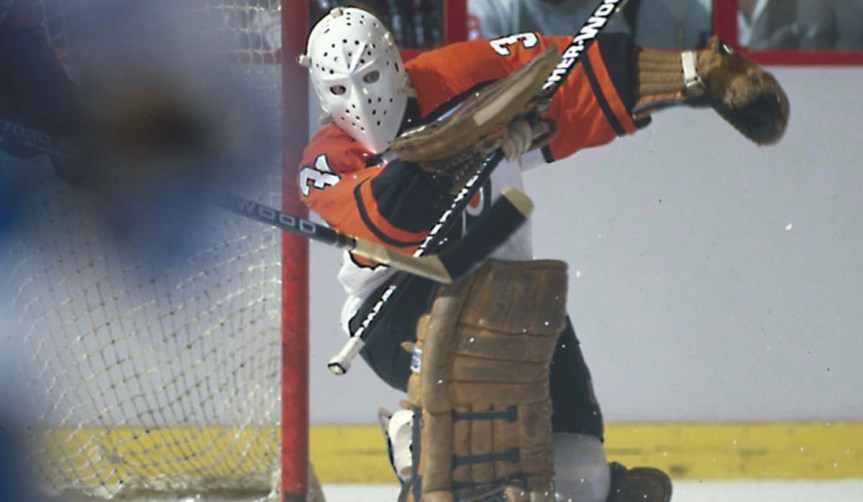
38 years ago, today, the terrible news of a 26-year-old Swedish goalie silenced both the sports world and the city of Philadelphia, forever.
Before the tragic morning of November 10, 1985, it felt like nothing could go wrong for the Philadelphia Flyers and Pelle Lindbergh who was playing at the top of his game, he had just won the Vezina Trophy in the 1984-85 season. The team was unstoppable, destined for greatness, but in the blink of an eye, a sadness gloomed over Philadelphia.
Pelle Lindbergh who was born on May 24, 1959, in Stockholm, Sweden. Grew up loving the game of hockey and would later be drafted 35th overall by the Philadelphia Flyers in the 1979 NHL draft.
In 1980 the Olympics were held in Lake Placid, where Pelle was named to Sweden’s national hockey team. The Swedes earned bronze with Lindbergh back-stopping them. The following year he would begin his career in the National Hockey League (NHL) and in 1984-95 he had a season to remember.
Pelle was named to the All-Star team and accumulated 40 wins, which led the entire NHL. In doing so he also became the first European-born goaltender to be awarded the Vezina Trophy with a 3.02 goals against average and .899 save percentage. The trophy winner and the orange and black made a push for the Stanley Cup Final that year. Lindbergh posted a 2.50 GAA, a .914 SV% and an outstanding 3 shutouts. Nonetheless, the Flyers met a god like Edmonton Oilers who defeated Philadelphia in five games.
The following season it appeared to be more of the same from the young Swede and the Flyers who were 10-2-0 and had an eight-game winning streak to begin the season. Pelle Lindbergh himself had a 6-2-0 record, earning a 2.88 GAA and a .855 SV% in 8 games. The winning streak continued and after a celebratory party that ran into the AM, Pelle Lindbergh decided to try and drive.
In the early morning of November 10, 1985, after the Flyers’ team party, Pelle Lindbergh was driving his red Porsche 930 Turbo just blocks away from the Flyers training facility in Voorhees, NJ, where he failed to navigate a curve and rammed his sports car into a wall in front of Somerdale Elementary School.
The Flyers’ team party was a little too much for the young Sweden who decided to drive. His blood alcohol level at the time of the crash was .24, which was well above the legal limit in New Jersey at the time (.10). Pelle also had two passengers in the car, who were both seriously injured but survived.
Pelle Lindbergh was only 26-years-old. He was pronounced brain dead and kept on life support until his father, Sigge, and family arrived from Sweden to say goodbye to their only son and give permission to put him to rest on November 11, 1985. His organs were harvested for donation and Pelle himself was laid to rest back home in Stockholm, Sweden in Woodlands Cemetery.
Scoop Cooper, long-time HockeyBuzz journalist and mentor who has been around the Flyers organization since 1969, was very close with Pelle Lindbergh and vividly remembers his time with him:
“I talked to [Pelle] a couple of hours before he was killed. They were playing Boston that night and it was a Saturday night. Bob Froese played because he was going to be traded to Los Angeles and they wanted to see him play one more time. [The Flyers’] next game wasn’t until the following Saturday against Edmonton, which was a very unusual thing because that was the team they had lost to in the Finals the spring before.
So Gump didn’t play. Frosty played and then [Lindbergh] was killed in the accident so the trade never happened.”
Cooper also has fond memories of Lindbergh playing for the Maine Mariners, the Flyers AHL affiliate before being named the Phantoms.
“I first became close friends of Lindbergh during his stretch playing for the AHL Maine Mariners which he helped reach the brink of a third Calder Cup title in four years in 1981 before losing out to the then veteran loaded Adirondack Red Wings in six games. In fact he gave me the orange LOUISVILLE goalie stick he used in the last game of the finals (which I still have) when our charter flight got back to Portland, ME, from Glens Falls, NY.”
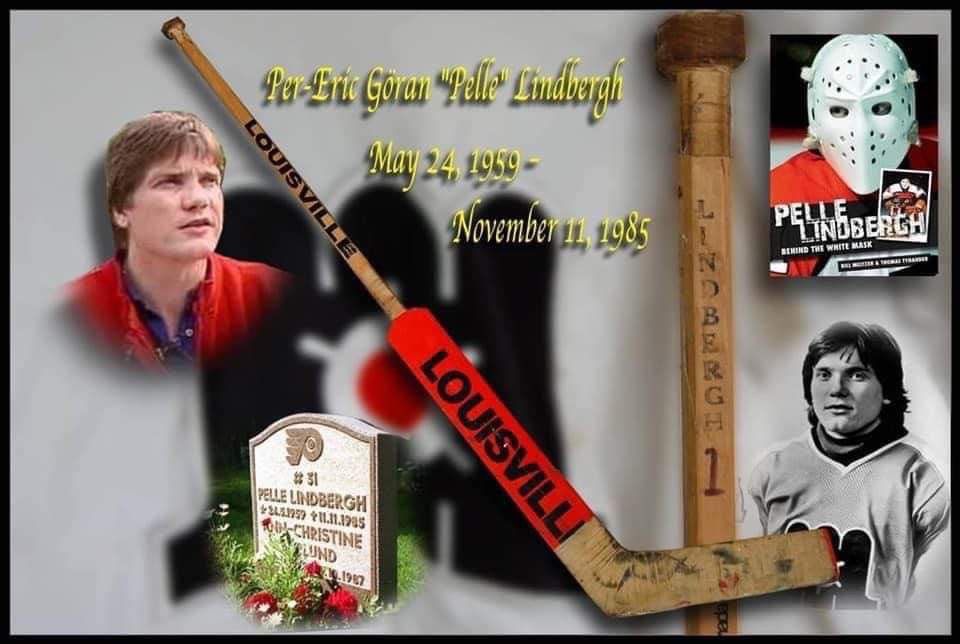
The death of the Flyers’ young prodigy netminder shocked the team, fan base, the hockey world, and his family. After just three days, the Philadelphia Flyers had to take the ice again, renting a bus for Pelle’s memorial service and their pregame service prior to their game on November 14, 1986.
The morning skate before that game against the Edmonton Oilers was nothing short of heartbreaking and displeasing. All of Pelle’s teammates were truly affected by the lose of one of their own.
His passing still glooms over Philadelphia, but not necessarily in a bad way. He will always be remembered as one of the Flyers greats.
Since the 1993-94 season the team has given out an award in his name (Pelle Lindbergh Memorial Trophy) to the club’s most improved player. In 1986 he was posthumously voted into his third NHL All-Star game, leading the league in voting. It was the first time any athlete was voted posthumously. The No. 31 may not be hanging in the rafters but out of respect, no Flyers player has worn the number since.
Pelle Lindbergh’s absence weighed heavy on the Flyers players and organization. Trying to continue on that season, Pelle’s loss became constant background static and the players were emotionally distraught. The burden became too much, especially with the empty stall in the old Spectrum being a constant reminder.
Since his passing, the Flyers have still yet to find a goaltender that matches the potential and the skillset he possessed — Lindbergh still ranks 10th for most games played by a goaltender in Flyers history and seventh in Flyers history for most wins by a goaltender.
Rest in peace, Pelle Lindbergh.
By: Dylan Robillard (@DylanRobillard_)
photo credit: SI.com
 brotherlypuck.com