
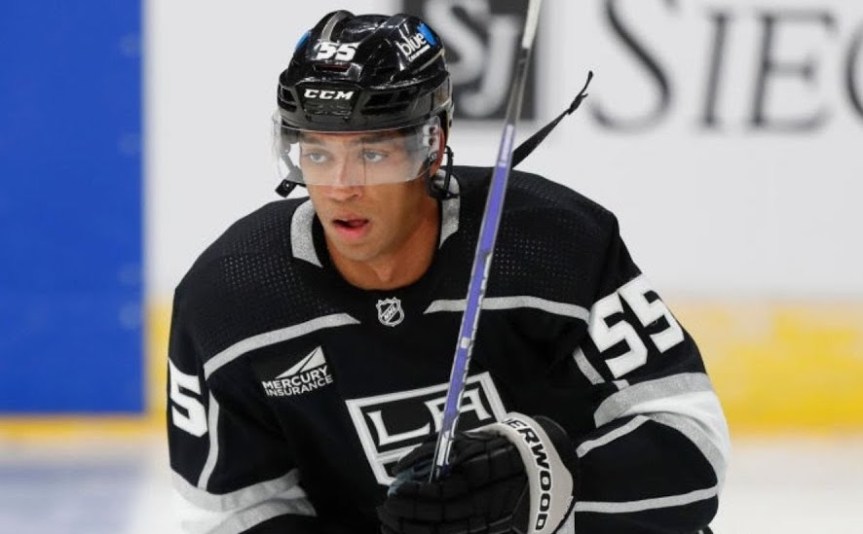
When Frank Seravalli made note that the Flyers and Kings have been talking, it was a bit surprising. Mainly because it’s hard to believe Danny Briere is doing anything as GM, but the Kings are fighting for the top spot in the Pacific Division and, at face value, don’t have an abundance of interesting options that the Flyers could be scoping out.
While the rumors haven’t specifically circled in on Quinton Byfield, there’s not exactly many players on the Kings’ roster that the Flyers could (or should) be linked to other than the 22-year-old center.
Byfield, the former second overall pick in 2020, is 22 years old with 210 NHL games under his belt. He has 101 points and is in the first year of a five year contract extension clocking in at $6.25 million per season.
So should the Flyers be interested in acquiring Byfield? Let’s weigh some pros and cons and find out.
Pros
He’s actively playing center
Unlike other trade targets we’ve discussed like Trevor Zegras and Dylan Cozens who have taken up residency on the wings, Byfield is actually playing at center. That hasn’t always been the case as he did shift to wing last year, but a transition back to his natural position rather than away from it makes him a potentially valuable piece the Flyers should be looking at.
He has a solid foundation
Again, in reference to Cozens and Zegras, those two have just been floating in the wind with serious questions to their overall capabilities, which specifically come into play with a coach like John Tortorella. Byfield doesn’t really have those questions. While his ceiling is still a bit unknown, by all accounts he’s playing well in roles up and down the lineup. It’s the kind of quality that makes a “rehab project” worth investing in rather than taking a gamble on name value.
What do the Kings want via trade?
Rumor has it the Kings want experienced wingers, something the Flyers have no problem matching. But do they want someone like Owen Tippett or a lesser Joel Farabee? Unlike Anaheim and Buffalo who are perennially rebuilding, crafting a big trade with a playoff team is a much different beast asset wise, and one where the Flyers should be a bit more willing to move main roster pieces rather than future assets.
Cons
Is Byfield good enough?
After having a bit of a breakout season in 2023-24 posting 20 goals and 55 points, Byfield has just 13 points in 30 games and is mainly playing in a third line role, though he is seeing time on both the power play and penalty kill. There’s nothing wrong with Byfield topping out as a responsible middle six center, but is he good enough to cure what ails the Flyers?
His contract
Byfield is in the first year of a five year extension paying him $6.25 million a season. It’s a large commitment for a team that isn’t exactly rolling in cap these days. It could get evened out in a trade, if they were to ditch Joel Farabee for example, but that’s still a big ticket for a player who hasn’t established himself as a top guy yet. The Flyers need to figure out a way to get away from contracts like that, not add more.
Conclusion
This isn’t the first time there have been loose connections between Byfield and the Flyers, he’s been a name that has bubbled up in trade rumors a few years ago when he was struggling to transition to the NHL.
It seems worth noting that despite the early season success, the Kings’ offense is 17th ranked with a 29th ranked power play. It means that the lack of offense coming from Byfield may not be his fault directly. If he shows up in Philly and is handed a bigger role and ends up playing alongside Travis Konecny or Matvei Michkov, the good times could start flowing much easier than in a depth role on the Kings.
It does make you wonder why the Kings would consider such a shakeup at this point, however. Word is they are in the market for wingers, which the Flyers have an excess of, and as noted in the intro, Byfield wasn’t directly mentioned by name, but he’s one of the only targets that make sense on their whole roster for the Flyers. Their other center options like Phillip Danault or Alex Turcotte don’t make a ton of sense to pursue at the moment.
One of the big problems we discussed in the Dylan Cozens entry was the contract. It’s not so much a “rehab project” as it is a gamble on a long-term commitment, and Byfield is no different. Four more years at a $6.2 million cap hit is yet another long-term, expensive commitment for a player that just may not be worth it. But basing a trade around main roster wingers works out well when it comes to shedding cap space. It may not help alleviate the Flyers’ cap problems, but it does reallocate some of their funds to a better position.
If they were to ditch, say, Farabee and Frost, use Byfield in a meaningful role and call up someone like Samu Tuomaala, that’s a decent shakeup of the forward group, even if the results aren’t exactly immediately game-breaking. Briere needs to consider these kind of changes wherever they present themselves.
Is Byfield enough to stop the bleeding at center for the Flyers? Probably not. They’re going to need to remain vigilant beyond a single player (be it Byfield or Cozens or whoever) when it comes to the trade deadline and offseason. If they snag two of these “rehab projects” in the rumor mill, that has a much better likelihood of working out not just on an individual player level but for the team as a whole.
In a sense, it’s good to hear that the Flyers are at least sniffing around options at center, but they actually need to capitalize on one of these trades. This deal may not be imminent, but as the trade deadline breaks on the horizon, it’s worth keeping an eye on the Flyers and Kings to see if there’s any fire to all this smoke.
By: Dan Esche (@DanTheFlyeraFan)
 brotherlypuck.com