
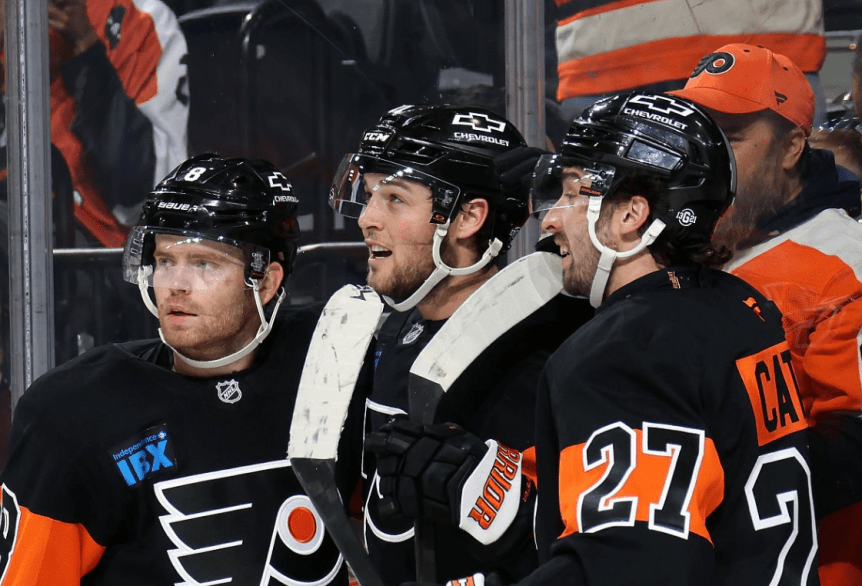
Before the Philadelphia Flyers can focus on the offseason festivities and tracking down any outside additions, they have to first deal with their in-house contract extensions. A few weeks back we made some predictions about the new deals for the team’s 2025 RFA class, but let’s gauge whether the Flyers should be re-signing them at all!
Noah Cates
There have been plenty of rumors that Cates will take the arbitration route for his next contract with the Flyers, which considering he only has one year left as a RFA, that means he can only sign a one-year deal. Now, a prove-it contract is probably the best path the Flyers could end up with for Cates’ next deal, as his history is a bit checkered when it comes to being a useful player, but historically, arbitration tends to lead to sour feelings and an eventual departure.
If the Flyers were a normal team, they would probably be weary of carving out a long-term spot for Cates. Sean Couturier is still here long-term to hold down the 3C spot, and Cates probably isn’t a full-time top-six center. He’s been in that role because the front office is incompetent when it comes to adding a center. But if Jett Luchanko makes the jump to the NHL in 2025-26 but just tops out as a middle-six dude, then they’ve got three 3Cs on the roster.
Though Cates’ individual trade value probably isn’t all that high either. But if the Flyers craft multiple blockbuster trades this summer (it won’t happen but we can dream, right?) then Cates’ rights could be a throw-in.
Realistically, it’s not the end of the world if they don’t re-sign Cates, but the Flyers re-sign everybody. Chances are, whether it goes to arbitration or not, Cates returns on what is hopefully a short-term deal that both sides can reassess in a year or two with an even larger sample size of his abilities.
Decision: Probably keep, but should probably trade
Tyson Foerster
The soon-to-be 24-year-old Tyson Foerster is coming off his entry-level contract, and is still one of the more intriguing untapped potential options on the roster. Foerster was pigeonholed as a defense-first player under John Tortorella, but may be one of the better forwards on the team in terms of raw skill as a goal scorer. His 25 goals and 43 points were both career bests, and he’s probably got more to offer.
The question becomes whether or not they go the bridge deal route, or do they try and give him a longer term contract at a medium sized cap hit in hopes it grows into a team friendly deal?
A two to three year deal hovering around the $3 million mark is pretty typical. In this case, with the cap expected to rise over the following few seasons, if Foerster is confident in his abilities, taking a bridge deal leads to a massive payday down the road, and it gives the Flyers a bit more flexibility in the short term considering every dollar is going to count this summer.
A five or six year deal hovering around $5 million (a.k.a. the Joel Farabee contract) could potentially age well, and it’s been a long time since the Flyers had a true team-friendly contract on the books. But, we reference Farabee because if the player sputters out, then it quickly turns more of an anchor than it does a positive.
One way or another, Tyson Foerster isn’t going anywhere anytime soon. If the Flyers feel as though they’ve got a diamond in the rough on their hands, they could very well go the longer term route this summer.
Decision: Keep
Cam York
The Flyers probably should re-sign Cam York, but the reality is we’ve got no idea what is going on behind closed doors when it comes to his relationship with the front office. Did removing Tortorella from the equation give York new life in Philly, or is the damage done and they’ve got another Ivan Provorov situation on their hands and York’s just gonna pout as long as he’s here?
The Flyers may have a bunch of bodies on the defense, but very few real options to replace York. Emil Andrae is probably their best bet, and he could very well be capable of doing it, but his integration into the NHL was handled about as poorly as possible over the last two years, so his ceiling is still cloudy at best.
If the Flyers were to legitimately enter the trade scene this summer looking for a center upgrade, York is their best trade chip (and the decision to move him could be easier if the bridges are burnt.) He’s already coming off a bridge deal, and most top young defensemen get a mighty extension for their first long-term contract. But York had the worst season of his young career, so handing him an 8 x $8 contract (or something in that ballpark) doesn’t feel like the best decision either.
He’s an RFA until 2028, so the Flyers are in no immediate need to make a binding decision here. Maybe another bridge deal is ultimately the best way to go for both parties. The Flyers can figure out whether or not York is a top guy, and York can be ready to pull the rip cord if things continue to not go well. A bridge deal probably comes in at a slightly higher AAV, but it may be worth to potentially avoid (another) disastrous max-term deal.
Decision: Keep
Jakob Pelletier
There’s no real reason why the Flyers would be re-signing Pelletier. Especially if the other RFAs sign new deals, Pelletier’s roster spot is literally the only open spot on the entire roster. If he inks a deal for a year or two around a $1 million cap hit, they can just send him to the Phantoms, or worse case he gets picked up on waivers which wouldn’t be a major loss. This team has bigger fish to fry than re-signing Pelletier.
Decision: Don’t re-sign.
By: Dan Esche (@DanTheFlyeraFan)
photo credit: Getty Images
 brotherlypuck.com